
Partial Knee Replacement (Unicompartmental)
Targeted knee replacement for isolated joint wear to improve movement and function
A partial knee replacement (unicompartmental knee replacement) is a surgical procedure used to treat arthritis affecting only one part of the knee joint. Instead of replacing the entire joint, this approach focuses on the damaged compartment, preserving the healthy bone, cartilage, and ligaments in the rest of the knee.
The knee is divided into three compartments: the medial (inner), lateral (outer), and patellofemoral (front) compartments. When arthritis is limited to one of these areas, a partial knee replacement may be considered as a more targeted alternative to total knee replacement.
By preserving more of the natural joint, this procedure aims to maintain a more natural knee movement pattern while addressing the source of pain.
Careful assessment is important to determine whether the arthritis is confined to a single compartment and whether this procedure may be appropriate for your individual condition, anatomy, and activity level.
- What is partial (unicompartmental) knee replacement?
- When partial knee replacement may be recommended
- Preparing for partial knee replacement surgery
- What happens during partial knee replacement surgery
- Understanding the risks and considerations
- What to expect after surgery
- Rehabilitation and recovery after surgery
- Long-term outcomes after partial knee replacement
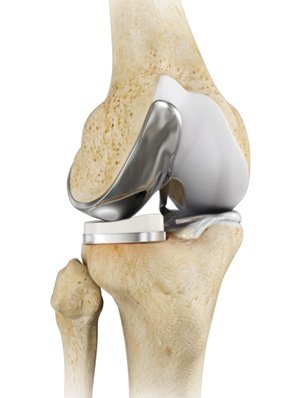
What is partial (unicompartmental) knee replacement?
A partial knee replacement, also known as a unicompartmental knee replacement, is a surgical procedure used to treat arthritis affecting only one part of the knee joint.
The knee is made up of three compartments:
- The medial (inner) compartment
- The lateral (outer) compartment
- The patellofemoral (front) compartment, between the kneecap and thigh bone
In some patients, arthritis is limited to a single compartment. In these cases, a partial knee replacement may be considered, where only the damaged portion of the joint is resurfaced, while the healthy bone, cartilage, and ligaments are preserved.
This approach differs from a total knee replacement, where all compartments of the knee are replaced. By retaining more of the natural joint structures, a partial knee replacement aims to maintain more natural movement and function.
The procedure involves placing specialised components on the affected surfaces of the joint to allow smoother movement and reduce symptoms associated with joint wear.
Careful assessment is important to determine whether the arthritis is confined to one compartment and whether this procedure is appropriate for your individual condition, anatomy, and activity level.
When partial knee replacement may be recommended
A partial (unicompartmental) knee replacement may be considered when arthritis is limited to a single compartment of the knee and symptoms are affecting your daily activities despite non-surgical treatment. This procedure is typically discussed after appropriate conservative management, such as physiotherapy, medications, or injections, has not provided sufficient relief.
Partial knee replacement may be suitable in situations such as:
- Arthritis confined to one compartment of the knee (most commonly the medial compartment)
- Persistent knee pain, particularly localised to one side of the joint
- Pain that affects walking, standing, or everyday activities
- Relatively preserved movement in the knee
- Stable ligaments, allowing the knee to function normally
In general, the surrounding knee structures, including the ligaments and unaffected cartilage, need to be in good condition for this procedure to be considered. Not all patients with knee arthritis are suitable for partial knee replacement. If arthritis affects multiple compartments or there is significant joint instability, other treatment options may be more appropriate.
Preparing for partial knee replacement surgery
Preparing for partial (unicompartmental) knee replacement surgery involves a combination of medical assessment, physical preparation, and practical planning to support your recovery. Before surgery, Dr Scott Tulloch will undertake a comprehensive assessment, including a clinical examination and imaging such as X-rays or MRI, to confirm that your arthritis is limited to one compartment and that this procedure is appropriate for your knee.
You will also be provided with pre-operative instructions, which may include guidance on:
- Fasting prior to surgery
- Managing or temporarily stopping certain medications
- Preparing for your hospital admission
- Organising walking aids, such as crutches, for use after surgery
Optimising your general health before surgery may support your recovery. This can include maintaining a healthy weight, stopping smoking, and continuing with appropriate strength and mobility exercises, where advised. It is also important to plan for your return home. After surgery, you may have temporary movement or weight-bearing restrictions, so arranging support from family or friends and preparing your home environment can help make recovery more manageable.
Dr Scott Tulloch will discuss the surgical plan, expected recovery, and rehabilitation pathway, helping you prepare and make informed decisions about your care.
What happens during partial knee replacement surgery
Partial (unicompartmental) knee replacement surgery is performed to treat arthritis affecting a single compartment of the knee, while preserving the healthy parts of the joint. The procedure is typically performed under general or regional anaesthesia, so you will be comfortable throughout. You will be positioned carefully to allow access to the affected area of the knee.
During the operation:
- A small incision is made at the front of the knee to access the joint
- The surgeon identifies the damaged compartment and assesses the surrounding structures
- The worn cartilage and a small amount of underlying bone are carefully removed from the affected surfaces
- The healthy ligaments and unaffected compartments are preserved
- Specialised implant components are positioned to resurface the damaged area of the joint
These components are designed to allow smooth movement and improved load distribution within the knee.
Once the implants are in place, the knee is checked for alignment, stability, and range of motion. The incision is then closed and dressed, and you will be transferred to recovery for monitoring. The procedure is generally shorter and less invasive than a total knee replacement, although the exact approach will depend on your individual anatomy and condition.
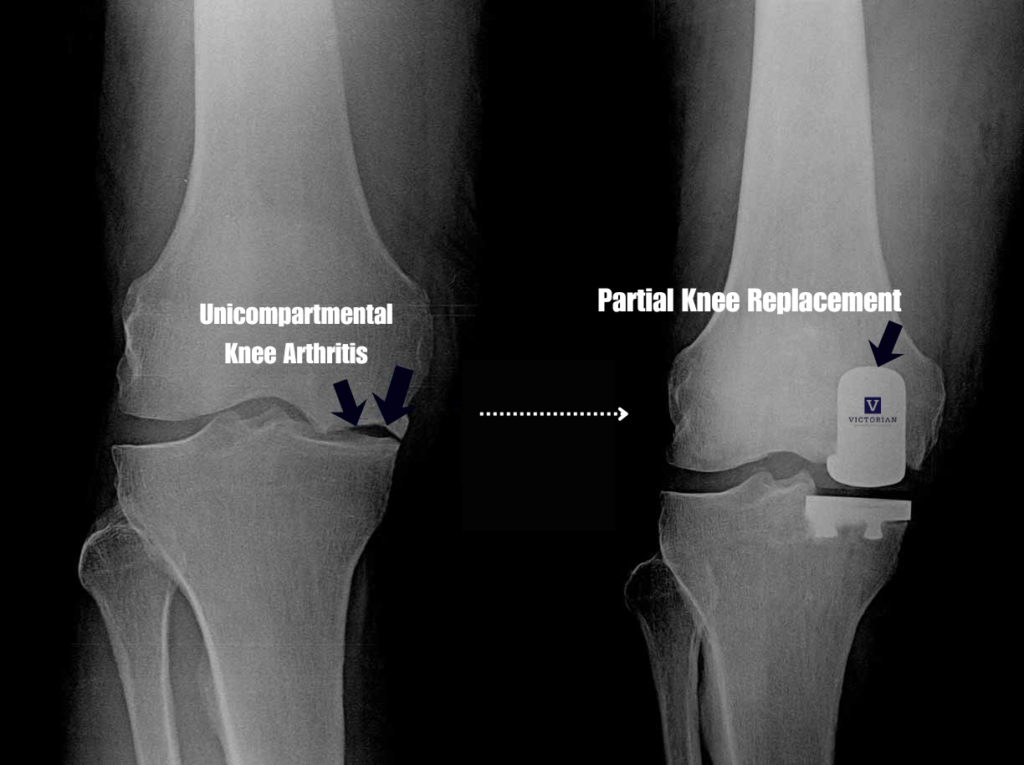
Understanding the risks and considerations
All surgical procedures carry potential risks, and partial (unicompartmental) knee replacement is no exception. Understanding these risks and considerations can help you make an informed decision about your care. Some risks are common to most operations and may include infection, bleeding, blood clots, and reactions to anaesthesia. These are carefully managed through standard surgical and post-operative care. There are also considerations specific to partial knee replacement.
These may include:
- Persistent pain or incomplete relief of symptoms
- Progression of arthritis in other parts of the knee over time
- Implant loosening or wear, which may develop gradually
- Instability or stiffness, affecting movement of the joint
- The possibility of requiring further surgery, including conversion to a total knee replacement
Because this procedure treats only one compartment, it is important that the remaining parts of the knee are in good condition. Careful patient selection is a key factor in determining suitability.
What to expect after surgery
Recovery after partial (unicompartmental) knee replacement is typically progressive, with a focus on reducing pain, restoring movement, and returning to daily activities.
Hospital stay
Many patients can return home on the same day or after a short hospital stay, depending on your overall health and the complexity of the procedure.
Pain management
It is common to experience pain, swelling, and stiffness in the early stages after surgery. These symptoms are usually managed with:
- Medications prescribed by your care team
- Ice (cold therapy) to help reduce swelling
- Gradual return to movement and activity
Assistive devices and mobility
You may need to use crutches or a walker in the initial recovery period to support mobility and reduce pressure on the knee. Most patients begin walking soon after surgery, guided by a physiotherapist.
Discharge instructions
Before leaving hospital, you will receive clear guidance on:
- Caring for your surgical wound
- Managing pain and swelling
- Gradually increasing your activity levels
- Recognising signs of complications
Early movement is encouraged, and you will begin a physiotherapy program to help restore range of motion, strength, and normal movement patterns.
Many patients are able to return to light daily activities within a few weeks, with continued improvement over time. Recovery can vary depending on your overall health, fitness, and response to rehabilitation.
Rehabilitation and recovery after surgery
Rehabilitation following partial (unicompartmental) knee replacement is an important part of your recovery, focused on restoring movement, strength, and confidence in the knee while supporting healing.
In the early stages after surgery, the priority is to regain movement and begin walking safely. You will usually start a structured physiotherapy program soon after surgery, with guidance on exercises to improve range of motion, strength, and circulation. Walking is encouraged early, often with the support of crutches or a walking aid, progressing as your comfort improves.
As your recovery progresses, rehabilitation focuses on rebuilding muscle strength, particularly in the quadriceps and surrounding hip muscles, as well as improving balance and movement control. This helps support everyday activities such as walking, climbing stairs, and standing for longer periods.
During the early stages of recovery, you will be advised to avoid high-impact activities to protect the joint and allow the surrounding tissues to heal. Activity levels are gradually increased based on your progress and symptoms.
Recovery timeline
Recovery after partial knee replacement is often progressive over several weeks. Many patients are able to return to daily activities within approximately 4 to 6 weeks, although this can vary. Continued improvement in strength and function typically occurs over time, with recovery progressing over the following months.
Your individual recovery will depend on factors such as your overall health, fitness, and response to rehabilitation.
Long-term outcomes after partial knee replacement
Long-term outcomes following partial (unicompartmental) knee replacement are influenced by your overall health, activity level, joint condition, and rehabilitation. Many patients experience relief from knee pain and improved joint function, particularly when arthritis is limited to a single compartment. Because this procedure preserves more of the natural bone and ligaments, it may allow for a more natural-feeling knee movement compared to total knee replacement.
Over time, most individuals are able to return to daily activities such as walking, work, and low-impact exercise. Maintaining muscle strength, flexibility, and a healthy level of activity can help support ongoing knee function. The implants used in partial knee replacement are designed to be durable, with many lasting 10–15 years or longer, although this can vary depending on factors such as activity level, body weight, and overall joint health. It is important to understand that outcomes can vary.
In some cases:
- Symptoms may persist or change over time
- Arthritis may develop in other compartments of the knee
- The implant may experience wear or loosening
As a result, some patients may require further treatment in the future, including the possibility of conversion to a total knee replacement if symptoms progress. Regular follow-up appointments are recommended to monitor the condition of the knee and implant over time. Maintaining a healthy lifestyle, including low-impact exercise and joint care, may help support the longevity of the procedure.
If you would like to learn more about partial knee replacement or discuss your individual situation, you can arrange a consultation with Dr Scott Tulloch to explore your treatment options and expected outcomes.